
Permutations
Permutations are a fundamental concept in mathematics and computer science, especially in problem solving. A permutation is an arrangement of objects in a specific order. Whenever the order of objects matters, we use permutations.
What is a Permutation?
Suppose you have 5 colored balls labeled 1, 2, 3, 4, and 5:
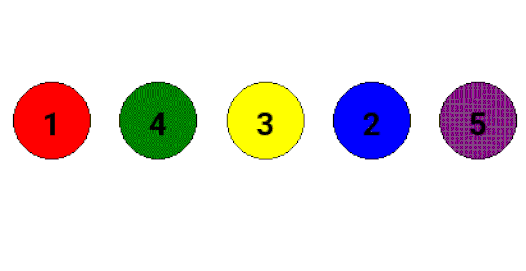
Figure: Five colored balls labeled 1, 4, 3, 2, 5 (one possible arrangement).
Each unique way of arranging these balls in a row is a permutation. For example, the arrangements (1, 2, 3, 4, 5) and (5, 4, 3, 2, 1) are different permutations.
Counting Permutations
- The number of ways to arrange distinct objects is (read as "n factorial").
Example:
For 3 balls (A, B, C), the permutations are:
- A, B, C
- A, C, B
- B, A, C
- B, C, A
- C, A, B
- C, B, A
There are permutations.
Permutations of r Objects from n
Sometimes, we want to arrange only objects out of . The number of such arrangements is:
Permutations with Repetition
If some objects are identical, the formula changes. For example, the word "LEVEL" has repeated letters. The number of distinct arrangements is:
where are the counts of each repeated object.
Permutations are used in many areas, such as algorithm design, cryptography, and combinatorial problem solving. Understanding permutations helps you solve problems where the arrangement or order of items is important.